
Intuit Credit Karma
Credit Karma, LLCFinance
4.7444.72K Reviews
- Version
- 26.46
- Installs
- 50.00M
- Age Rating
- Everyone
Screenshots

Our Review of Intuit Credit Karma
 Analysis by Appyee
I treat a credit score as a signal to investigate, not a verdict on my financial life. That is the most useful way to approach Intuit Credit Karma: it brings credit information into a place I can check regularly, then gives me context for what may be shaping it. For someone who has only looked at credit when applying for a card or a loan, that regular view can make the subject feel less mysterious.
Credit Karma is a free finance app from Credit Karma, LLC. Its average rating is 4.7 from around 3.1 million ratings, and it has over 50 million installs. It is rated for Everyone, so the audience is broad, though the information is most useful to people who are actively managing credit. The app first appeared on February 28, 2013, and version 25.50 requires Android 9 or later.
A recurring view of your credit, not a magic fix
The main appeal is that I can review my credit score and reports without paying for that access, and checking through the app does not affect my score. That distinction matters: looking at your own credit is different from a lender reviewing it as part of an application. I would use the app for awareness and planning, not as a promise that a particular action will produce a particular score.
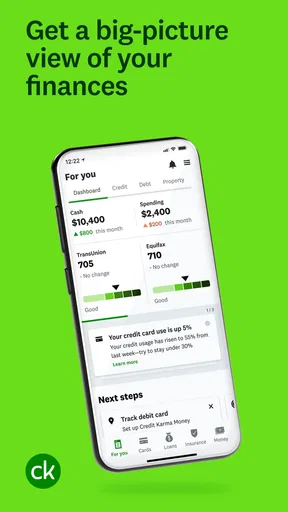
It presents scores from two major bureaus and offers personalized suggestions for improving credit. Those details are useful together. A score gives me a quick snapshot, while the report breakdown helps me look for the reasons behind it. If a number moves, I can check the underlying information instead of reacting to the change alone.
Putting the credit simulator to work
The feature I find most worth exploring is the credit score simulator. It lets me model possible actions, such as paying off a credit card or taking out a loan, and see how they might affect my score. I read “might” as the key word: the result is a planning aid, not a forecast I would treat as guaranteed. Real outcomes depend on the details of a person’s credit profile and what actually happens afterward.
A practical way to use it is to compare a few choices before making a decision. If I am considering paying down a balance, I can look at the scenario in the simulator, then weigh that possible credit effect against my cash needs and other obligations. I would not borrow simply because a simulation seems favorable, or postpone a sensible payment because the result looks disappointing. The tool is most helpful when it sharpens a question I already have.
How I would fit it into an ordinary week
Imagine I am planning to apply for an apartment or a new card in the coming months. I could check the app, review the score and report details, and note anything I do not recognize. If something looks off, I would investigate the report rather than assuming that the score alone tells the whole story. If everything looks familiar, I could use the simulator to think through a planned balance payment and return later to see whether my overall picture has changed.
That routine is more useful than repeatedly opening the app to chase every small movement. Credit scores can fluctuate, and one change does not automatically mean I need to take action. I would check in when I have a reason—before a major application, after changing how I use a card, or when a notification points me toward a report detail. Notifications for significant changes can help draw attention to something worth reviewing, but I would still verify the underlying information before making decisions.
The report breakdown adds another practical layer: it highlights areas that have the greatest effect on the score, helping me decide where to focus. I would treat that as a way to prioritize questions, not as a complete financial plan. For example, it can point me toward a factor to understand, but it cannot decide whether paying down debt is better for my household than keeping cash available for an upcoming bill.
Where suggestions help—and where I stay cautious
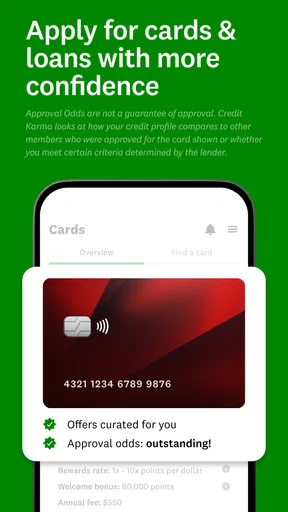
The app also presents tailored suggestions for credit cards, loans, and savings accounts. That can be convenient when I am already comparing options, since it puts possible products alongside the credit information I am checking. Still, a recommendation is not the same thing as neutral advice. I would compare the terms and costs of any product independently and ask whether it fits my needs, rather than choosing it simply because it appears in a personalized list.
This is an important trade-off for a free finance app: product suggestions sit alongside monitoring tools. I would keep those purposes separate in my head. I can use the report and score features to understand my credit, then decide on a card or loan only after reviewing the details that matter to me. If I want a simple place to inspect credit information, those offers may be easy to ignore; if I want advice with no product recommendations mixed in, a different source may feel more comfortable.
Compared with checking only through a bank or card issuer, Credit Karma brings together scores from two major bureaus and a report breakdown in one app. A bank’s own credit feature may be more convenient if I already use that institution, while the app’s broader view can be helpful when I want information beyond one account. Neither replaces checking the relevant report carefully when I am preparing for a consequential application.
Interface, privacy, and practical limits
The interface feels clean and approachable in my experience. Sections are arranged so I can move between credit information and suggestions without having to learn a complicated system, and color-coded areas help distinguish parts of the app. That simplicity is welcome for a topic that can otherwise feel intimidating. At the same time, a tidy screen cannot make every credit detail easy to interpret; I still need to read what a report entry means and follow up when something is unfamiliar.
Because the app handles sensitive financial information, I would approach sign-up thoughtfully and use care with the account details I provide. The app describes security measures for protecting information, which is reassuring, but no app should make me careless about safeguarding access to a financial account. I would also avoid treating a phone notification as proof that an issue is urgent or resolved; it is a prompt to open the relevant information and check it for myself.
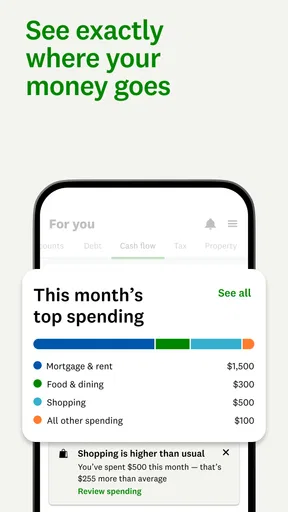
Credit Karma is less suited to someone who wants a full household budget, transaction-by-transaction spending plan, or a single place to manage every financial account. Its strongest role here is credit monitoring and related guidance. If my main task were tracking monthly expenses, I would choose a budgeting tool built around that job instead of expecting this app to provide a complete money-management system.
Who is likely to get the most from it?
I would recommend trying it if you want a no-cost way to keep an eye on your credit, are preparing for a major financial application, or simply want to understand what factors are affecting your score. It can also suit someone who benefits from a regular nudge to review a report rather than waiting until a lender raises a question. The simulator is especially useful for people comparing possible credit-related actions, provided they treat its output as an estimate for consideration rather than a promise.
I would skip it if credit monitoring is not a priority, if product suggestions would make the experience feel distracting, or if I needed detailed budgeting and account management instead. I would also avoid using a simulated score change as the sole reason to take on debt or rearrange money I need for everyday expenses. The app can inform a choice; it cannot make that choice safe or right for every person.
What Makes It Tick?
So, what’s the deal with Intuit Credit Karma? Well, first off, it offers free access to your credit score and reports. Yes, you read that right—free. And the best part? It doesn’t affect your credit score when you check it through the app. That’s a huge relief for anyone worried about the impact of frequent credit checks.
Using the app is super straightforward. Once you sign up and provide some necessary details, you’ll get access to your credit score from two major bureaus. It’s like having a secret window into your financial profile! The app also gives you personalized tips on how to improve your score, which is pretty neat if you’re looking to make some financial improvements.
Features That Stand Out
One of the coolest features I found is the credit score simulator. It allows you to see how certain actions—like paying off a credit card or taking out a loan—might impact your score. It’s like a crystal ball for financial decisions!
Another handy feature is the detailed breakdown of your credit reports. The app highlights areas that are affecting your score the most, helping you focus on what needs attention. Plus, with notifications for any significant changes, you’ll always be in the loop.
Intuit Credit Karma also ventures into the realm of finance management by offering tailored suggestions for credit cards, loans, and savings accounts. It’s not just about monitoring; they’re all about optimization too.
The User Experience
Let’s talk design and usability. The app sports a clean, intuitive interface that even the least tech-savvy among us can navigate with ease. Everything is laid out in a way that makes sense, without overwhelming you with too many options at once. The color-coded sections help in quickly identifying what’s what, making the entire experience smooth and stress-free.
Security is another aspect where the app shines. With robust measures in place to protect your information, you can rest easy knowing your data is safe. It’s a comforting thought when you’re dealing with something as sensitive as your financial information.
Wrapping It Up
In a world where keeping track of your finances can be a daunting task, Intuit Credit Karma makes it a breeze. Whether you’re planning to buy a house, consolidate your debts, or just want to keep tabs on your credit health, this app has got you covered. With its user-friendly design and insightful features, it’s more than just a credit monitoring tool—it’s your financial health partner.
So, if you haven’t already, give it a whirl. It might just be the financial eye-opener you’ve been looking for!
Privacy and Permissions
See what permissions an app requests and how it handles your data.
- Location
- approximate location (network-based), precise location (GPS and network-based)
- Phone
- read phone status and identity
- Photos/Media/Files
- read the contents of your USB storage, modify or delete the contents of your USB storage
- Storage
- read the contents of your USB storage, modify or delete the contents of your USB storage
- Camera
- take pictures and videos
- Microphone
- record audio
- Wi-Fi connection information
- view Wi-Fi connections
- Device ID & call information
- read phone status and identity
- Other
- view network connections, pair with Bluetooth devices, access Bluetooth settings, change network connectivity, full network access, change your audio settings, control Near Field Communication, run at startup, reorder running apps, control vibration, prevent device from sleeping
Verdict
Strengths of Intuit Credit Karma
- User-friendly interface for easy navigation.
- Free credit score tracking and reports.
- Personalized financial recommendations.
- Alerts for important credit changes.
- Secure access with robust encryption.
Limitations of Intuit Credit Karma
- Limited international support.
- Occasional ads can be intrusive.
- Some features require account linking.
- Data accuracy depends on reporting agencies.
- Limited customer support options.
Similar Picks in This Category
View All
Google Wallet
Google LLC4.3

Airtel: Recharge, Bank & Loans
Airtel4.0

PayPal - Pay, Send, Save
PayPal Mobile4.2

DANA Indonesia Digital Wallet
PT Espay Debit Indonesia Koe4.5

Binance: Buy Bitcoin & Crypto
Binance Inc.4.8

Cash App
Block, Inc.4.7
Frequently Asked Questions
What features does Intuit Credit Karma offer to users?
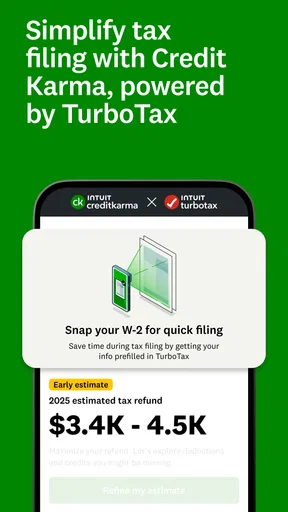
Intuit Credit Karma provides a range of features including free credit score monitoring, personalized financial insights, and tailored recommendations for credit cards and loans. It also offers tools for tax filing and identity monitoring, helping users make informed financial decisions and track their financial health over time.
Is Intuit Credit Karma safe to use for monitoring my credit?
Yes, Intuit Credit Karma is safe to use. It employs advanced encryption and security measures to protect user data. Additionally, it does not store your bank login credentials. Users should ensure they download the app from official app stores to avoid security risks associated with counterfeit apps.
Does using Intuit Credit Karma affect my credit score?
No, using Intuit Credit Karma does not affect your credit score. Checking your credit score through the app is considered a soft inquiry, which does not impact your score. This allows you to monitor your credit health regularly without any negative effects.
How often is my credit score updated on Intuit Credit Karma?
Intuit Credit Karma updates your credit score weekly. This frequent update schedule enables users to stay up-to-date with any changes in their credit report, helping them manage their credit health more effectively and address any discrepancies promptly.
Are there any costs associated with using Intuit Credit Karma?
Intuit Credit Karma is free to use. There are no hidden fees or subscription costs for accessing your credit scores or financial insights. The app generates revenue through advertising and offers personalized financial product recommendations, which are optional for users.
